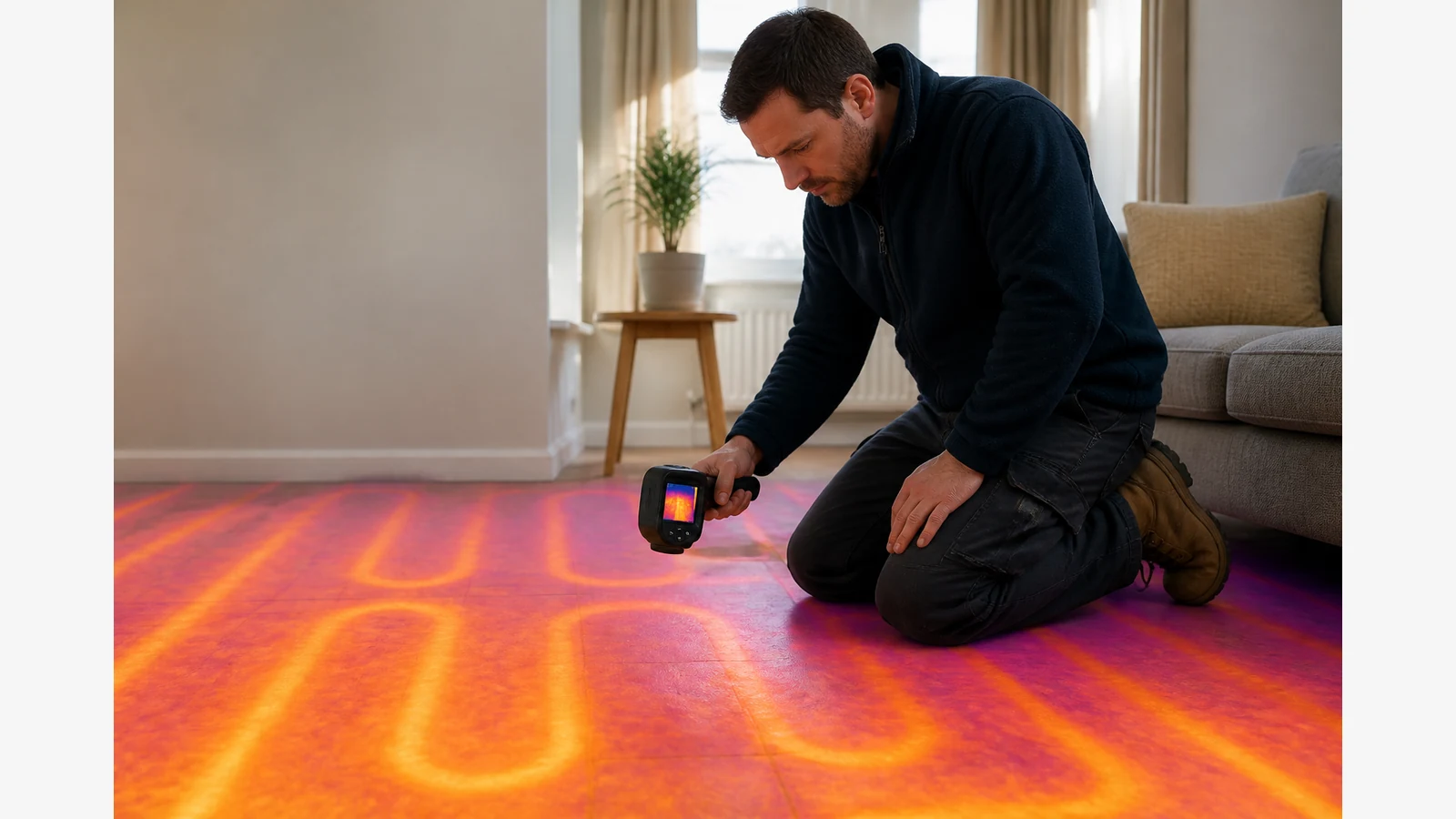
Thermal camera for underfloor heating UK: map loops before lifting floors
A thermal camera for underfloor heating in the UK shows warm pipe runs and cooler gaps once the system is running, so you can map loops before lifting floors or drilling. It does not measure flow rate, leak volume or moisture content — it maps surface temperature patterns that help you decide where to investigate next.
Why heating engineers reach for thermal imaging on UFH call-outs
UK trade guidance treats underfloor heating mapping as a core handheld thermal use case before opening floors. Once loops are warm, serpentine heat patterns usually appear through screed and many coverings, letting you follow runs from the manifold without guesswork. That is why many engineers prefer imaging before demolition on dense domestic layouts.
For packed pipe centres, public UK guidance commonly cites at least 160×120 IR resolution and sensitivity under 100 mK as a practical starting point for separating neighbouring loops. Thicker carpets, commercial manifolds or long working distances may need a step up — see our thermal camera resolution guide for UK trades.
UK site constraints that decide whether the image is useful
- Run the system long enough for useful surface contrast before you scan.
- Scan steadily; stop on blank, fading or asymmetric sections rather than chasing single-pixel noise.
- Thick coverings and high thermal mass reduce contrast — wait longer or note where upgrade resolution may help.
- Keep a still for the client file whenever you recommend opening the floor.
Trade round-ups also list UFH mapping among everyday handheld jobs for electricians and allied trades who need to avoid accidental pipe strikes — useful context if you share sites with other contractors (Elec-Mate thermal imaging guide).
Decision path on site
- Start at the manifold and confirm which loops are calling for heat.
- Follow the bright warm runs across the floor plane.
- Flag blank or fading sections as blockage, balancing, leak or insulation suspects — then corroborate with pressure, flow and visual checks.
- Only open the floor where the thermal map and other evidence converge.
If the job is really a suspected micro-leak rather than pipe tracing, pair this workflow with your usual leak methods and our related plumber buying checklist. Occasional UFH work may also suit hire first — compare options in hire versus buy for UK trades.
Spec checklist for UFH tracing
- True IR detector resolution (not display megapixels alone).
- Thermal sensitivity suitable for dense domestic layouts.
- Close-range usability in tight plant cupboards and living rooms.
- Still-image capture for client evidence and handover notes.
When to upgrade or hire a higher-spec body
Complex commercial manifolds, thick screeds or formal report packs with fine edge detail may need higher resolution than a compact 160×120 trade camera. Treat 160×120 as a common minimum for many domestic diagnostics, not a universal guarantee under carpet or at distance.
Next step
If UFH tracing is a weekly call-out, shortlist a durable compact trade camera and compare it against hire for peak weeks. You can review a same-site product example on the FLIR TG165-X thermal camera detail page after you have matched the camera to your dominant job type.